Sunday, 7 April 2024

GL057: The Low Country Part 4:

We left Charleston, S.C. on March 25th, for the run to an anchorage near McClellanville. The day was very windy and quite nasty, but thankfully there was little traffic--only the Fort Sumter tour boat that we could see in the distance. We passed the Sullivan's Island and Isle of Palms area--these form the barrier islands and are the closest beaches if you live in the Charleston or Mt. Pleasant area.  It was a pretty quiet run, and we reached our intended destination, an anchorage area outside of McClellanville off Town Creek. This area was quite exposed because it was a grassland, and although we tried to anchor, we were not happy with the swing room or wind protection. We made a quick call to Leland Oil Company and Marina and were able to secure dockage for the night, although space was tight. KatMat ended up rafting off to us.

The town was a short way up Jeremy Creek where we could see a large shrimping and crabbing fleet. McClellanville was founded in the late 1850's as a summer retreat from inland heat for planters of the Santee Delta. Today it has a population of about 600, and no downtown to speak of, but Matt, Kathy and Nancy took a walk to the Carolina Seafood Company, a local fish market with seafood right off the dock.  Nancy bought some crab dip, which came highly recommended from previous Looper comments. 

An old tree::


Shrimp boats:


On the 26th, we left first thing in the morning for the run to Georgetown, S.C.  Georgetown is another Looper favorite stop. The plan was to anchor right off downtown, where there was a convenient city dinghy dock for day use. On approach to Georgetown, you can't help but notice the huge industrial complex, which is comprised of the Georgetown Steel Mill, which is responsible for the majority of manufacturing jobs in the area, and the Georgetown Paper Mill, owned by and operated by International Paper. We are told there is often a bad odor in the air, but the wind must have been blowing in the right direction, because we never smelled it.

A reading of the Waterway Guide revealed that the holding in the Sampit River anchorage right off downtown was "sketchy" due to a more "fluffy" or silty bottom. The anchorage was also crowded with 6-8 derelict boats and many more live aboard locals taking up valuable real estate. It was difficult to squeeze in between those already anchored, staying out of the navigation channel but also far enough away from any shallows on the opposite bank, and we rode around for some time scouting out locations and testing depths. Matt and Kathy moved further upriver and anchored there.

Lots of shrimp boats in Georgetown:


Once settled, Nancy and I headed into town by dinghy.  There is a boardwalk, known as “the Harborwalk,” along the waterfront.  We toured the small downtown and took a a guided tour of the Kaminski House, a Georgian Style Antebellum house on a bluff overlooking the Sampit River with a rich history. The home was built sometime between 1750 and 1800 by Paul Trapier, a leading merchant of French Huguenot decent, who later deeded it to his daughter, Elizabeth, to increase her marriage prospects. It must have worked because in 1778 she married a widower, Edward Martin, who was a "merchant" in Charleston, active in the importing of slaves. In 1931 by Harold Kaminski, the son of Heiman Kaminski, one of Georgetown's most prominent merchants during the latter part of the 19th Century, and his wife Julia. Harold had many successful business interests and also served as Mayor of Georgetown. He was a Navy officer during WWII and was on duty at Pearl Harbor on the morning of December 7, 1941.  When Julia died she donated the home and all its furnishings, but stipulated that nothing be moved, added or subtracted in perpetuity. So, it hasn't, down to the placement of the knickknacks on the shelves

Unmoved knicknacks   (I have the whole set of these monks in a box from my mother.   Syrup, milk, sugar, and salt and pepper): 


 Afterwards, we toured the Maritime Museum, which was free to enter: bonus!  We finished up our day with dinner at the River Room Restaurant on the Harborwalk. We sat at a table overlooking the water and it was a very pleasant evening.

Georgetown:


On the 27th, I was starting to feel ill (cold) as was Matt.  I gave Nancy and Kathy a dinghy ride to town, and they went touring.  Highlights:

-Rice Museum on Front Street: before cotton was king, it was rice in this area.  As much as 236,000 acres of previously untouched land was transformed into about 120,000 acres of tidal rice fields and roughly 116,000 acres of inland rice fields. Enslaved people did the work.  These areas are natively cypress swamps or upland pine forests, and the slaves had to first perform the back-breaking labor of clearing the land using hand tools and oxen to cut down and remove the trees, pull out stumps, and then backfill the swampy areas with soil moved from elsewhere. It took at least 8 years for a native cypress swamp to be cleared--the work was so difficult and the ground was so wet and soft, that the oxen had to wear special "shoes".


-Gullah Museum, which is a small organization dedicated to remembering the Gullah  history and culture.  Gullah history is told through story quilts and artifacts--many of which were made by the museum's founder Bunny Smith Rodriquez. Her quilts are prized and sought after and her Michelle Obama Story Quilt is part of the permanent collection of the Smithsonian's National Museum of African American History and Culture in Washington, DC. (Michelle Obama's great-great-grandfather on her father's side, Jim Robinson, was born into slavery in 1850 on Friendfield Plantation near Georgetown)


On the 28th we left Georgetown and headed up to the Wacca Wache Marina, a small marina with only sixteen slips (and fewer transients) right on the Intracoastal waterway. It was a very peaceful setting, with unspoiled views up and down the Waccamaw River and an unobstructed western exposure for sunsets over the cypress swamps. 

By Friday, the 29th, Matt and I were both in full-blown sick mode and we stayed on the boats while Nancy and Kathy rented a car to sight see.   We all went to dinner in Murrell’s Inlet (has to be the highest concentration of restaurants anywhere) but I was not really “felling it.”   

 Sights from the area:


Sculpture museum:


Everywhere George Washington went is celebrated:


On Saturday, I had to replace the gasket on Hygge’s water heater as almost a quickly as we filled the water tank, it emptied.   I had seen this problem before and thought to have a spare gasket on the boat.   Matt gave me “moral support” as I crawled under bunks and took out access panels to get to the water heater.    Leak fixed, we left the dock and  took a short ride over to a lovely anchorage and dropped the hook in the Bull Creek.   Nancy and I went exploring via the dinghy up several creeks and found a wildlife refuge to walk around for a bit.  Later that night my hopes of Illinois making the Final Four in the NCAA tournament were bashed in the first eight minutes of the second  half of the game against UConn.        

Anchorage:


Creek exploring:


Wildlife Refuge:


Not sure where the “Low Country” officially ends, but for our purposes, this is where I’ll end it as tomorrow, we head through Myrtle Beach.


Dave

Odometer: 3,157 n/m

Saturday, 30 March 2024

GL056: The Low Country Part 3:

March 19th was notable for two reasons.  The first was that I turned 64 years old and second, we crossed 3,000 n/m’s on our trip: so, just over halfway.

The day started with Matt and Kathy having us over to Katmat for a birthday breakfast.   We then headed to Beaufort, SC, electing to stay at the Safe Harbor Beaufort Marina which is adjacent to downtown.  That night we had a birthday dinner “in town” at a pretty decent restaurant, the Old Bull Tavern.   The next day, on the advice of a friend, Dave Beecken who lives on nearby Brays Island Plantation, we took a horse drawn carriage ride through the historic district.  We weaved around the historic area, focusing on the many large homes in "The Point" neighborhood. All, with few exceptions, are privately-owned, the oldest of which is the Thomas Hepworth House (1717). Back in the day, the Point was a very desirable place to live because of its proximity to the cooling breezes coming off the water.

Our two-horsepower carraige:


Houses on "The Point:


A cool hotrod:


The most interesting resident, with a house still standing, was Robert Smalls, a former slave. Later in his life Mr. Smalls owned the home at 511 Prince Street, originally constructed circa 1840 by Small's enslaver, Henry McKee.  Robert Smalls was born there, but as a young man he was "hired out" to work in Charleston where, among other jobs, he worked aboard a transport boat known as "The Planter" and became a skilled pilot. He freed himself, his crew, and their families during the Civil War by commandeering The Planter and piloting it from the Confederate-controlled waters of the harbor through the Union blockade, where it later became a Union warship. His example helped convince Abraham Lincoln to accept African American soldiers into the Union Army. Following the war, Smalls returned to to Beaufort where he purchased his former master's house, which Union tax authorities had seized in 1863 for refusal to pay taxes. Smalls later was a politician, publisher, and successful businessman. His is an incredible story!

That evening we went to dinner at Breakwater Restaurant and Bar with Dave Beecken and his wife Kitty: a very nice opportunity to catch up. 

On the morning of the 21rst, Nancy, Kathy and I took an Uber over to the Cypress Wetlands area in nearby Port Royal. Not a large area, but well worth the visit.  We came to a boardwalk that ventured out from the treed area and into an area that can only be described as like a "Garden of Eden." There was a clump of trees in the middle that contained hundreds of birds--Wood Storks, egrets, anhinga’s, and others, all moving around. We were told it was the mating season and there was courtship behavior being displayed. There were many people there on the boardwalk with cameras, and Nancy got a terrific shot of a Wood Stork flapping its wings at a nest with a chick. There were also many small alligators lining the opposite bank. The scene was mesmerizing. After a full walk around, we returned to the boat.

The Boardwalk:


A gator with Forest Gump's feather?

The view:

Mother and chick:


We left Beaufort and headed up to the Toogoodoo Creek anchorage, which was marsh-lined and mostly with minimal wind protection, although further up we did find some trees.  We scouted out different spots before deciding on one way up the Creek, located several hundred feet from the only house on the waterway, which was flying a Confederate flag underneath the American flag on its dockside flagpole. On our first attempt to anchor, we realized that we would swing into a crab pot, so we moved nearby, and we held fine with plenty of swing room.

Sunset:

On March 22nd, we left Toogoodoo Creek relatively early, in order to get to the dock at the Safe Harbor Marina in Charleston in time to beat any bad weather.  The trip to Charleston was relatively uneventful except that you could feel the wind picking up and there were several open areas where the water was chaotic.  We contacted the Marina to let them know that we were in sight of the Coast Guard Station, as they instructed, and a dockhand was waiting for us when we pulled up and we docked a the “mega dock” next to “Kokotea,” a 120’ sailing yacht made in New Zealand with a home port of Bloody Bay, Jamaica. The "mega dock" is 1,500-ft long and we later learned that a new dock under construction would be 3,000-ft long with slips for 500-ft yachts.  It was a long trip to the restroom! 

Nancy, Kathy and Matt took the marina shuttle into Charleston while I stayed behind to work.   Later I joined them for dinner in town.   On the way back it was pouring rain, and by the time we made it down the 1,500’ dock, we were all soaked.

We set ourselves up for a full day of sightseeing on Saturday. Matt declined to join, so it was myself, Kathy and Nancy. We started at the Old Exchange and Provost Dungeon on Bay Street--Charleston's most historic building. Completed in 1771, the Old Exchange Building has been the site of some of the most important events in Charleston's history. It was originally built as the customs house, and at that time its location was right on the waterfront (several blocks were filled in since). Over the years, the building has been a commercial exchange (including for slave auctions), customs house, post office, city hall, jail, military headquarters and museum and been the property of the British, United States, Confederacy, and Charleston City governments. It is now owned by the SC State Society of the DAR.

Sites:


The Exchange:


The basement "dungeon" of the The Exhange:


Sights:


The Pineapple Fountain:


 From the Old Exchange we visited The Old Slave Mart, also known as Ryan's Mart, which was a large slave trading complex opened on Chalmers Street in 1859, after the City banned public auction of enslaved people (and other goods) from the streets near the Exchange Building--it just moved several blocks into a "private" enclosed complex where the genteel folk would not see it. This complex originally included a slave auction gallery, morgue (the dead house), kitchen building, large yard and a 4-story bar raccoon (slave jail). The area behind the Chalmers Street building, which once contained the barracoon and kitchen is now a parking lot.

 Our next stop was the Heyward-Washington House on Church Street (1772), where we did individual audio tours. This was built by Thomas Hayward, Jr., one of four South Carolina signers of the Declaration of Independence and a home that can truly boast that "Washington Slept Here". The City rented the house during the President's week-long stay in 1791. The house is special because of its age and because of its intact 1740's kitchen building with slave quarters above, a privy and formal gardens.

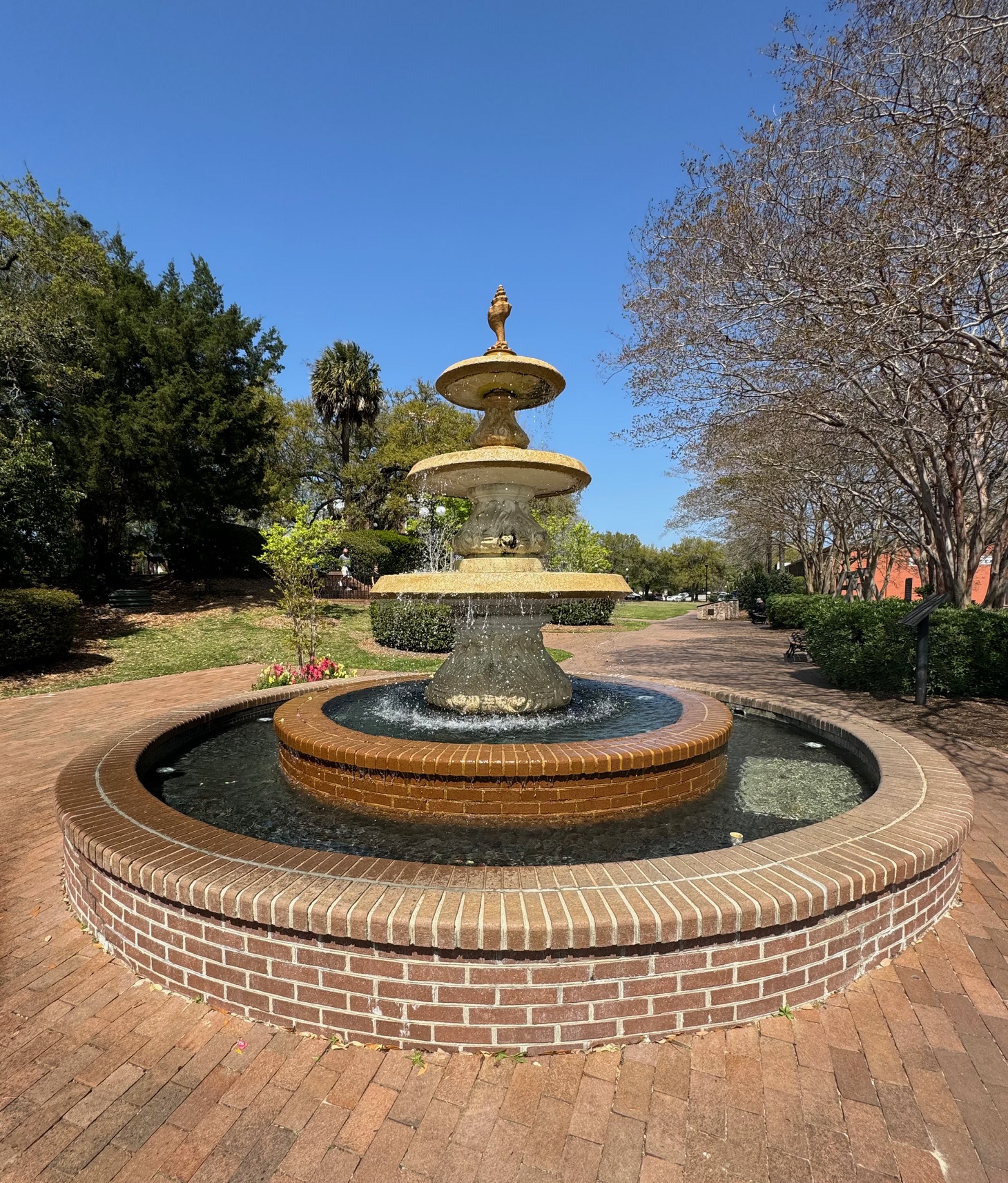
We then walked through the Joe Riley Waterfront Park, a very busy area with lovely walkways lined with benches, azaleas, live oaks and, you guessed it, dripping with Spanish Moss. The ultimate destination here was the infamous Pineapple Fountain and it did not disappoint. There was quite a crowd there, including children with their shoes off playing in the water. The fountain was a three-tiered affair, crowned by a large pineapple sculpture with water running through it, great spot!

On Sunday, the 24th, we got up early and went to the Liberty Square Fort Sumter Visitor Center for a ride over to see Fort Sumter. We boarded the Tour Boat "Spirit of the Low Country" at for the 9am departure, joined by a large group of seniors who were off a cruise ship. The ride to Fort Sumter was about 35 minutes, out through the Harbor to the middle of the channel where it empties into the Atlantic Ocean. 

The ride was narrated by a ranger from the National Park Service.  My favorite part of his talk was about the origins of the Civil War.  He neatly dispensed with the revisionist history of "states rights" being the cause and read from the South Carolina Declaration of Secession (its about slavery) and quoted the Vice President of the Confederacy, Alexander H. Stephens’ “Cornerstone Speech” who said this about the U.S. Constitution:

Those ideas, however, were fundamentally wrong. They rested upon the assumption of the equality of races. This was an error. It was a sandy foundation, and the government built upon it fell when the "storm came and the wind blew."

Our new government is founded upon exactly the opposite idea; its foundations are laid, its corner- stone rests, upon the great truth that the negro is not equal to the white man; that slavery—subordination to the superior race—is his natural and normal condition. This, our new government, is the first, in the history of the world, based upon this great physical, philosophical, and moral truth.

Well, tell that to people like Mr. Smalls!

Once we arrived, the exploration of the Fort was self-guided. As a bonus, since we were the first tour of the day, we witnessed the daily raising of the American flag over the Fort


Construction of Fort Sumter began in 1829, and the "island" that the Fort is on is man-made, built on a sand bar from thousands of tons of granite transported from New England and placed by enslaved people.  Its construction was intended to defend the region from a naval invasion, built after British forces captured and occupied Washington, DC during the War of 1812. Because of technical challenges, funding issues, unpleasant weather and disease, the interior and armaments were never fully completed by 1861. 

Of course, Fort Sumter is where the Civil War began on April 12, 1861 when the South Carolina Militia artillery fired from shore on the Union Garrison.  The bombardment continued all day.  As the fort had been cut off from its supply line and Union Commander Major Robert Anderson surrendered the next day rather than risk having the powder magazine suffer a direct hit from artillery fire. He took the Union flag with him as they evacuated, and the rest, as they say, is history.

The war took its toll on Ft. Sumter and by the end it was mostly just a pile of bricks, but it was rebuilt not quite to its former glory, but still a formidable defensive position until finally turned over to the National Park Service in the mid-20th Century.

Interior:


A cannon shell still embedded in the wall:


A post-Civil War cannon:


After the visit we “mooched around” the City Market for a bit and had lunch then did some grocery shopping.  Matt and I took our respective groceries back to the boat while Kathy and Nancy did more sightseeing.    That evening a Red Sea Dive Trip Buddy of mine who lives in the area joined us for dinner at a (forgettable) restaurant nearby, but getting caught up with her compensated for the poor service and so-so food.   She was kind enough to drop us back off at the marina for a long walk back to the boats.


Dave


Odometer: 3,074.


Friday, 22 March 2024

GL055: The Low Country Part 2

The morning of March 11th the anchor came up clean, but my windlass was struggling, and I had to lift the last twenty feet of chain by hand.  This reminded me that I had neglected to perform some routine windlass maintenance.  (Note that for this portion of the Great Loop you will experience tidal ranges as much as nine feet with the associated strong ebb and flood currents.  We planned our anchoring accordingly and saw 180-degree swings between high and low tides.)

Our next stop was Jekyll Island, most famous for being the site of the former Jekyll Island Club, winter residence of some of America’s wealthiest families from the late 1800’s until the 1942 (it is estimated that the members of the Jekyll Island Club represented 1/6th of America's wealth.)  The Club consisted of a hotel, condominium and mansion-sized “cottages” owned by the likes of the Morgans and the Pullitzers.   Their activities included socializing, biking, horseback riding, hunting, fishing, tennis, beach bathing and croquet. The impact of the Great Depression and Word War II greatly diminished the financial viability of the Club and in 1947 the State of Georgia used its powers of Eminent Domain to buy the island from the Club.   Luckily, many of the structures were maintained, and today serve as hotels and meeting facilities.    

We got a slip at the Jekyll Harbor Marina, which isn’t the fanciest marina going but the staff was friendly (as was the marina cat), and the showers and hot tub were hot.  The courtesy bikes and golf carts were also a big plus.   The first afternoon we took the bikes and did a short tour of the Historic District (the Club area) and then road over to the Beach District.

 
Friendly Cat:


Looking for friendly cats no doubt:

The next day we rode over to the museum and took a two-hour tour of the Historical District which was worth the $20 price per person.   Later that day Nancy and buddy-boat crew member Kathy Murphy took advantage of the courtesy golf cart to visit “Driftwood Beach” and stop in at the small market on the Island for a few essentials.  In the meantime, I attended to the never-ending list of boat maintenance items.

The Hotel:


A "Cottage:"


Sunset:

The following morning, we took one of the golf carts over to the hotel for breakfast to experience what it would have been like to dine like J.P. Morgan, though my attire was much less formal than what was required back in the day.   We left that dock at noon and headed north to St. Simon’s Island after a $5 pump out and topping off the fuel tanks at a reasonable, for the area, price for diesel.

There are many interesting things to see on St. Simon’s Island: plantation house, light house and museum, heritage center, colonial fort, “kayakable” marshes, etc.  We had seen many of these sites on a prior visit, so we elected to anchor off the Fort Frederica National Monument area and just visit the ruins of the colonial-era fort.   There is a serviceable dinghy dock at the Fort, and we enjoyed our walking tour of the area and its visitors center.  We had a very quiet night “on the hook” and caught a lovely sunset.

 Colonial Fort:


Anchored out:

The following day we began took our time, traveling slowly to enjoy the unique Low Country scenery.  Traveling at six knots allowed us time to take in the bird and dolphin sightings.  That day we anchored at "Crescent River 2" and then took an hour (against the ebb tide) dingy ride up the nearby creek to the rustic Fish Dock at Pelican Point Restaurant on the Sapelo River.   We had an early dinner to make it back down the creek before low tide set in.  (The trip back took thirty minutes with the ebb tide now helping us.)   The quiet and calmness of this anchorage was almost disconcerting as we have become accustomed to some level of movement while on the hook.

The Boys:


The next day we headed north, making a midday stop off the northern end of St. Catherine’s Island for a beach walk. Anchoring just off the beach we took the dingy to shore. The island is privately owned by a foundation that “aims to promote conservation of natural resources, the survival of endangered species, the preservation of historic sites, and to expand human knowledge in the fields of ecology, botany, zoology, natural history, archaeology, and other scientific and educational disciplines.”  It is known for a ring-tailed lemur captive breeding program as they are an endangered species.   Luckily the beach is accessible to visitors, though we did not see any of the elusive lemurs.

 Off St. Catherine's:


That evening found us anchored at "Ossabaw Island-Cane Patch Creek" for perhaps the nicest anchorage of the trip so far.  Not even a passing thunderstorm could disturb the calmness of this anchorage. 

We arrived in Savannah, GA on the 16th of March, too late to Uber in to see the St. Patrick's day Parade, but the thousands upon thousands of visitors that day, we weren't sorry to miss it.  On St. Patrick's day visited the historic area, taking a trolley tour.   We wanted to see any and all things "Forrest Gump" since portions of that movie were filmed here.  Very interesting place and they have done great things with the riverfront area, the lobby at the JW Marriott Savannah Plant Riverside District alone is worth the trip to Savannah!  

JW Marriott:


One of the lovely squares in the Historic District:


Riverfront:


We left Savanah and bypassed a stop at Hilton Head because we’d been there before and because my golf clubs were “left behind” for this trip.  We slowly made our way up the ICW, losing count of the number of dolphin sightings and anchored at 'Inner Bull Creek' which was nicely protected and had shore access for exploring in the woods.

 Dave

Odometer: 2,985 n/m

Saturday, 16 March 2024

GL054: The Low Country Part 1

On March 6th we left the free dock at Jim King Park in Jacksonville, FL and took a short ride over to Fort George Island site of the historic Kingsley Plantation (open Wed-Sun).   Despite staying in the channel, we touched bottom for a bit, but found deeper water hugging the Island.   There is a nice free dock at the Plantation for day usage with a two- hour limit (not that we saw anyone timing us).  The dock:


Touring the Kingsley Plantation made for a nice day stop.   The plantation house dates to 1798 (making it the oldest still standing plantation house in the State of Florida), but unfortunately is closed to visitors.   Several outbuildings (kitchen, stable) are open and contain exhibits documenting the history of the area, the plantation, Mr. Kingsley, and the slaves who worked there. Mr. Kingsley owned over 32,000 acres of land and lived an interesting life full of contradictory values to say the least*. Of special significance is the ruins of many of the slave quarters which were made with Tabby Concrete construction, thus the longevity.  There is a great audio tour available as well.    

Plantation House:

Slave Quarters:

Later that day we arrived at Fernandina Beach on Amelia Island at the Fernandina Harbor Marina planning to stay for two nights, but we liked it so much we stayed for three.  Fernandina Beach has a lovely downtown area with lots of shops, restaurants, historic homes, and Florida’s oldest tavern.   


On the 7th I had a late breakfast with an old work colleague who lives on the Island while Nancy “mooched around” town.   We then walked around the historic district to see the older homes that are still inhabited and maintained and dipped into a large resale shop but left empty-handed.   A miniature golf course in the downtown area provided a nice bit of entertainment.    

The next day we broke out the folding bikes and cycled over to Fort Clinch State Park for some nature walks and a tour of Fort Clinch and a walk on the beach to look for sharks’ teeth.  The fort was garrisoned on an off through the years but gradually fell into disrepair until the Great Depression, where workers of the Civilian Conservation Corps (CCC) began a restoration of the Fort.

After coming empty on sharks’ teeth, we then road over to the main beach and caught a Lyft ride over to the American Beach area to see the A.L. Lewis museum which celebrates Mr. Lewis, his great-grand daughter, Marvyne Elizabeth Betsch and the American Beach community.  Abraham Lincoln Lewis (A.L.) was the President of the Afro-American Life Insurance Company and a self-made millionaire, who used the Afro's Pension Bureau to purchase about 216 acres in two parcels starting in 1935 on the south end of Amelia Island in order to create an oceanfront resort where African Americans could enjoy "recreation and relaxation without humiliation" during the Jim Crow era (when they were banned from most beaches). 

As land was cleared, oceanfront homes were constructed. Over the next thirty years, the American Beach resort became a very popular and sought after destination, drawing visitors from all across the Southeast.  Hurricane Dora of 1964 unfortunately devastated American Beach, and then the passage of the Civil Rights Act of 1964 struck a further blow as African-Americans now had access to other public beaches. As people moved on, American Beach lost much of its land and establishments to encroaching development but still retains its proud history.  Marvyne was instrumental in keeping the legacy of her great-grandfather and the area’s historical roots alive.

We planned to do a walking tour of the area but the roads were torn up.  A chance-roadside discussion with the director of the museum indicated that after eighty years of asking the area is finally getting water and sewer lines put in.   

After getting a ride back to the main beach and having lunch “beach-side” we rode our bikes over to the second historic district on the north-side of the Island known as Old Town Fernandina and some interesting houses.  

On Saturday the 9th, we went to the Farmers’ Market in downtown in the morning and I spent the rest of the day on boat maintenance chores having decided to stay an extra day to further enjoy the area and wait out some sketchy weather.    

On Sunday, we left Fernandina Beach after one last stop at the local coffee shop and headed to Cumberland Island and crossed into Georgia leaving Florida for the first time since just after Thanksgiving Day.  We anchored off the northern of the two docks available for day use (no boats over 25’ allowed) and took the dinghy in.

We were greeted in front of the Ranger Station there by a woman from Georgia who was there volunteering with her husband for three months. They were checking in passengers coming off the ferry, day trippers as well as families of campers arriving with all their gear.  She recommended the River Trail down to the Dungeness Ruins, former winter home (59 rooms) of Thomas Carnegie, brother and business partner of Andrew Carnegie.   We then took a boardwalk thru the marshes over to the beach for a long beach-walk back up to a hiking trail through the hammock, spotting the Island’s famous feral horses going about their business.

River Trail:


Ruins:

Feral horse:

Beach walk:


Hammock trail:


A personal highlight for me was talking to some of the young children of the camping families and seeing the excitement of their Island Adventure through their eyes.   Like the families camping for the week, we could have easily spent a few more days exploring the Island, but we were anxious to get to our next stop.


Dave

Odometer: 2,842


* Zephaniah Kingsley: Slave trader, slave owner: progressive?.  He fathered eleven mix-raced children. He often allowed slave families to stay together, did let them keep some of their own customs and names, and to hire themselves out when their work was completed to earn money to purchase their freedom for 50% of their “market value.”  believed in inter-racial marriage and had four African "wives" at the same time, although only one, Anna, who was his favorite, did he actually marry.  In 1837, subsequent to becoming part of the United Statues, Florida passed laws outlawing interracial marriage.  Knowing his marriage to Anna would no longer be recognized, and that his mixed raced children migh might be confiscated and sold as slaves, he bought over 30,000 acres and moved everyone to to Haiti (in an area that is now The Dominican Republic). He believed in and operated under a system based on Spanish law as had been implemented in Florida where there were three social tiers: whites, free people of color, and slaves and that recognized interracial marriages.  The U.S. southern system was more of a binary "caste system" with whites having rights, and everyone else, not-so-much.  


GL085: Epilogue (and last Great Loop post)

  After tying up to the dock in Sturgeon Bay our first stop was over to the Get Real Cafe, for the best meal around Sturgeon Bay (farm to ta...